These days I’m a casual gamer, if at all. If I’m in the mood, I enjoy a resource-management game – you know, running a pizza parlour, chopping sushi, something like that.
But back in the day I’d happily immerse myself in a classic puzzle-adventure.
Broken Sword is the one that stays with me most. A point-and-click story that takes the player through the streets and catacombs of modern-day Paris to uncover a Templar-era conspiracy. The game combined lavish settings, mystery, humour, and a spark of romance with a structured and compelling story. (Watch the enjoyably overblown trailer here.)
A special mention must also go to Grandad 2: In Search of Sandwiches. In the 90s indie developers had to sell their wares in the back of computer magazines. You’d mail off a cheque for a few quid, and a week later a floppy disk would pop through your letter box. Grandad 2 was a classic low-fi indie game – a puzzler in its own right, albeit with much lower stakes and less salubrious setting – leaning heavily on a particularly British sense of humour.
Video games have been around long enough now that people who spent their youth indoors staring at a screen playing games are now spending their middle years indoors staring at a screen writing books. The influence of games on storytelling is showing in some interesting ways.
Seven Deaths
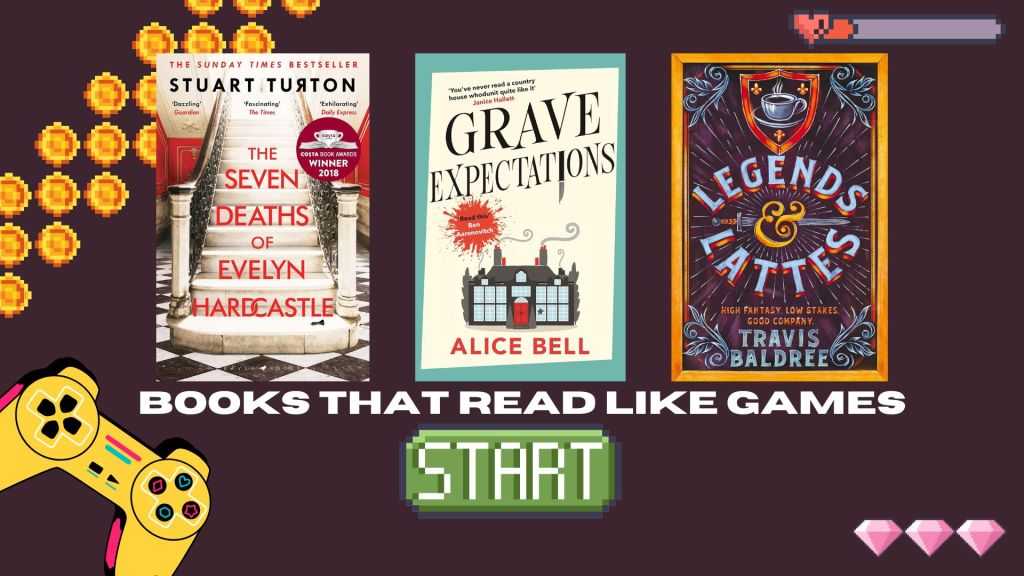
The Seven Deaths of Evelyn Hardcastle by Stuart Turton was the first book that made me aware of this link. The story takes a golden age country house murder mystery and gives it a body-hopping twist: the detective moves between different characters, reliving the same few hours from different perspectives, and can only escape by solving the crime.
If you’ve played any of the Assassin’s Creed series, the mechanics of the story should be familiar. In fact, early on and controlling one of the more vigorous characters, we have our detective pull the classic open-world game trick of trying to see how far off-map he can go. In fact – and this isn’t a spoiler – the end echoes the weird overarching world and story that links the Assassin’s Creed games.
Anyway, don’t take my word for it, here’s an extract from an interview Stuart Turton gave to Eurogamer:
So how central are games to his life? “Very. I play something every single day,” he says. “Sometimes I’m knee-deep in writing, and it’s genuinely taxing, it’s genuinely hard, and all I want to do is get into a DOOM and let my hands do the work – I don’t want my brain doing too much. Whereas I have other days where I’m massively frustrated by the writing and I need something super-absorbing to pull me away from the problems I’ve been working on, because that distance will help me solve them. I carve out an hour for myself a night, even when I’m writing. It’s crucial for me.”
It means even though Turton didn’t intend gameyness in his Agatha Christie novel, it creeped in anyway. He subconsciously pulled from the things which shaped him. “I went to video games and did not realise I was doing it!“
https://www.eurogamer.net/how-a-lifelong-diet-of-games-influenced-the-seven-deaths-of-evelyn-hardcastle
Grave Expectations
Grave Expectations by Alice Bell is another country house murder mystery with a games-adjacent vibe. But this time Claire, the principal investigator, has a companion: Sophie, the ghost of her murdered schoolfriend. Think Randall and Hopkirk (Deceased) with an ironic millennial twist.
A set of rules are quickly established for the ways in which Claire and Sophie can work. Claire is ridiculous and unreliable enough that people dismiss her as she collects evidence and useful objects in her bag (gamey, right?). Meanwhile, Sophie can walk through walls, secretly listen to conversations, but has no physical presence so can’t rifle through drawers or turn pages looking for evidence. Except when Claire and Sophie touch, Sophie is able to exert some small force on the world, but it drains Claire’s energy.
With a richly drawn locations for scenes, a rules-based plot, and object collecting Grave Expectations shares some common ground with Broken Sword or other mystery games. It’s perhaps unsurprising that Alice Bell works as a video games journalist.
Legends & Lattes
And then we come to Legends & Lattes by Travis Baldree, a low-stakes cosy fantasy that follows the life of Viv the orc after her final epic quest. Viv rocks up in Thune to seek out the perfect site to convert for a coffee house. She converts an old livery with the help of Cal the carpenter, recruits Tandri the succubus to help run the shop, and builds a kitchen for Thimble the ratkin to bake goods.
The slow building of capabilities as the coffee crew grows – illustrated by the ever-growing menu slate – and the need to balance attracting customers, handling queues, managing stock levels, and juggling various threats – is more than reminiscent of resource management games. I was convinced Travis Baldree must have worked in the industry.
His bio in the back of the book mostly talks about his work as a narrator, but lo, on his website, he describes himself as an ‘erstwhile veteran game developer’.
So books are games, yeah?
If you’re writing a genre book, the chances are that you’re thinking about rules and mechanics. Maybe consciously, maybe not. But all elements of world-building – from a cosy murder mystery set in a bucolic village through to an epic fantasy saga putting the fate of the manyverse into the multi-gauntleted hands of a millipede-scholar-turned-reluctant-assassin – are about rules.
Who was where when? Who knows what? What are the limitations of their abilities? How might their abilities combine with those of other characters? What’s gravity like in this world? Does oat milk exist? Can this happen in this world? And in what unique configuration can all those elements come together to resolve the conflict at the heart of a story?
This is a theory that’s been slowly brewing for a while now. I started writing The Rules of Time Travel back in 2020. It pre-dates the pandemic, but I don’t think I could have written it without lockdown and the strange time-dilation of living the same day over and over and over.
And, as an incidental detail, after the first week of lockdown I dug out my old N64 and wired it up to start a play through of Eternal Darkness (crazy in-depth history of the game here). A week or two in, our TV gave up the ghost and my nostalgia trip of gaming was over (much to my partner’s relief).
But reading back through my manuscript as I hurtle towards my target publication date in July 2024, I can see more than a trace of game mechanics. I’ll be talking more about that as we get closer to launch.
If you’d like to be kept up to date about The Rules of Time Travel (and be amongst the first to receive the free prequel The Mayfly when it comes out later this year) then sign up to my mailing list.
 L.A. Birchon
Leave a comment